Showing posts with label Henrik Ibsen. Show all posts

Sunday, 9 March 2014

Macaroons and female autonomy (part 2)

I thought it would be incredibly difficult to discuss how the macaroon holds such socio-political power within Ibsen's A Doll's House without making it myself, which will be the basis of this entry. I am following Mary Berry’s recipe, which makes 10 macaroons:

For the macaroon shells:

· 125g/4oz ground almonds

· 200g/7oz icing sugar
All of the ingredients.

· 3 free-range egg whites

·2 tbsp caster sugar

·½ tsp cream of tartar

· A few droplets of red food colouring

For the chocolate filling:

· 200g/7oz dark chocolate, chopped

· 200ml/7fl oz double cream

· 1 tsp brandy

· 15g/½oz unsalted butter

Method:

·         Blend the ground almonds and icing sugar in a food processor until well combined. Set aside.

The consistency should look similar to a meringue!
·         Using an electric whisk, slowly whisk the egg whites in
       a large bowl at a low speed until stiff peaks form when the whisk is removed. Slowly whisk in the cream of
      tartar and caster sugar until the mixture is smooth and glossy, gradually increasing the speed of the whisk
       as the mixture stiffens.

·         Gently fold in the food colouring and blended ground almonds and icing sugar until the mixture resembles shaving foam.
  
·         Spoon the macaroon mixture into a piping bag fitted with a 1cm/½in round nozzle. Pipe 5cm/2in circles onto the baking tray lined with greaseproof paper. If a peak forms, wet your finger and smooth it down. Sharply tap the bottom of the tray to release any air bubbles from the macaroons, then set aside for 60 minutes (the macaroon shells are ready to go in the oven when they are no longer sticky to the touch).
  
·         Meanwhile, preheat the oven to 160C/315F/Gas 2½.

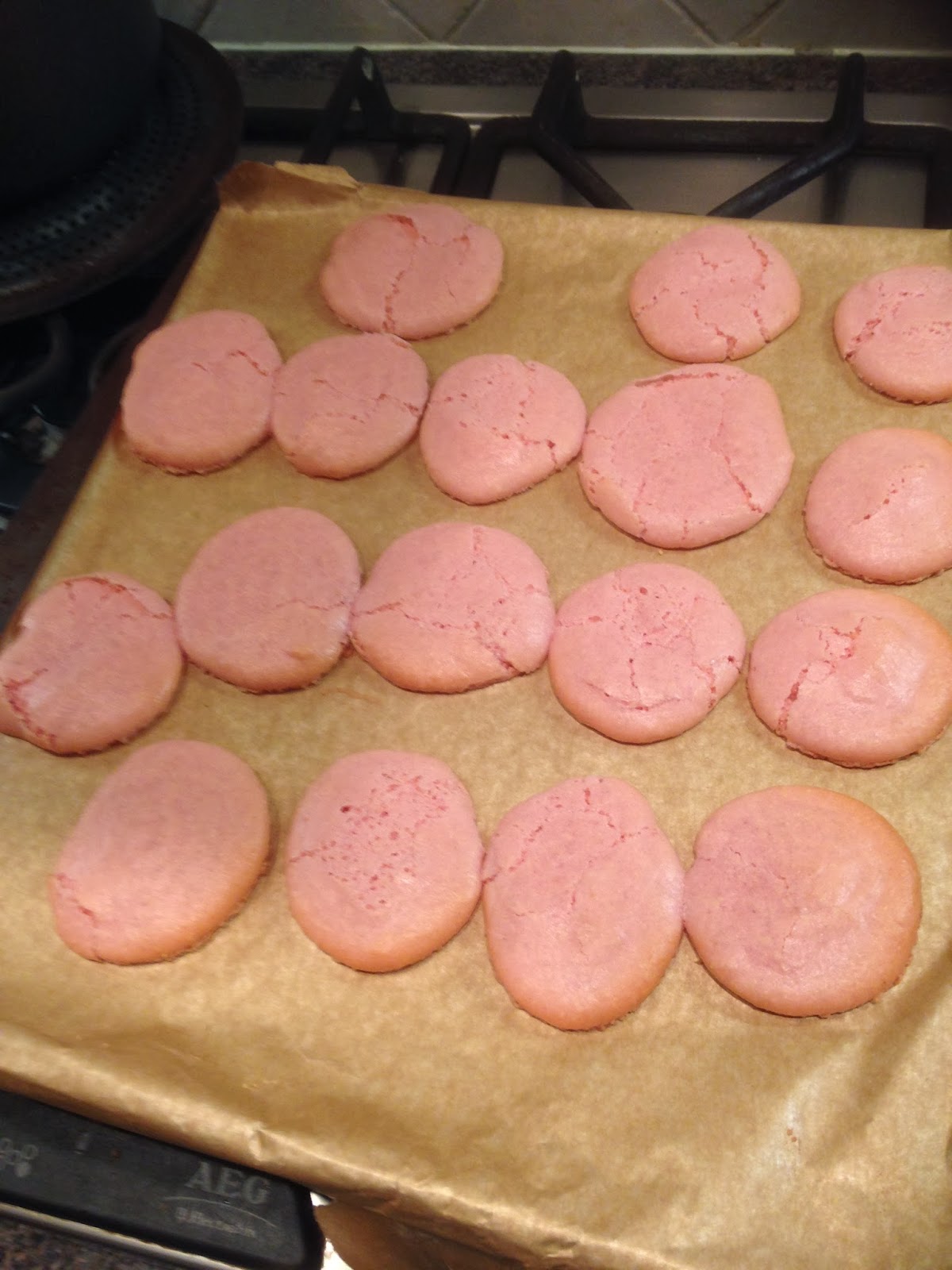
·         Bake the macaroons in the oven for 10-15 minutes, or until cooked through. Remove from the oven and set aside to cool for 5 minutes. Carefully peel away the greaseproof paper and set aside to cool completely.
 ·         Meanwhile, for the chocolate filling, heat the double cream and chocolate in a saucepan over a low heat, stirring occasionally, until smooth and well combined. Add the brandy and butter and stir until smooth, then remove from the heat and set aside to cool completely.


·         Use the filling to sandwich the macaroons together then chill in the fridge for 30 minutes.

Applying this back to Ibsen’s text the instructions alone shows the attention to detail and skill needed in order to make these successfully. I will put my hands up for possibly being the world’s worst when it comes to using a piping bag, as the misshapen shells in the pictures demonstrate. In saying that, although I followed the recipe word for word I somehow ended up with 14 macaroons! The small amount of food colouring I used made the macaroon a pastel pink, a colour stereotypically associated with femininity. While the shells were light, airy and sweet, the chocolate filling was incredibly rich and slightly bitter due to the dark chocolate. It was this juxtaposition of indulgent flavours that made it impossible to eat more than one per sitting 


Works Cited:
Berry, M. “Macaroons” (2014). BBC Website <http://www.bbc.co.uk/food/recipes/macaroons_16105=>  Date accessed 01/03/14
Ibsen, Henrik. A Doll's House. Trans. Meyer, Michael. London: Metheun Drama, 1991.


Sunday, 2 March 2014

Macaroons and female autonomy (part 1)


It is not often that we think of macaroons as anything more than delicate, small and sweet treats. It is even less likely that the connection between the two shells consisting largely of ground almonds sandwiched between a flavoured filling with feminism. However, for Norwegian playwright Henrik Ibsen’s prose drama A Doll’s House, the representation of the lightly baked confectionary acts as a symbol to challenge the marriage norms in the nineteenth century. First performed in 1879, the naturalistic problem play unearths the deceptions and consequent independence of Nora Helmer from her husband Torvald. Although there are only a few references to macaroons in the play, they become a poignant symbol for Nora’s defiance. Audiences are introduced to this sense of dishonesty at the start of the play, as one of the stage directions defines the conflict between Torvald and Nora, as she “takes from her pocket a bag containing macaroons and eats a couple. Then she tiptoes across and listens at her husband’s door” (23). Although initially this does not seem significant, Nora’s tiptoeing behind her husband’s back suggests to audiences that the Helmer household is not as simplistic as it may initially seem.

Sidney W. Mintz has researched into the morality associated with sugar. He argues that from about the mid-seventeenth century onward, the consumption of sugar, at least in the West, appears to have been colored by moral judgements, both positive and negative” (67). I think by applying Mintz’ ideas of the moral associations of sugar to Ibsen’s play an audience can explore the underlying dialogue of between Nora and Torvald.  It is this duality that ultimately allows an audience to interrogate how femininity should be portrayed in society. From Torvald’s perspective, Nora’s consumption of macaroons suggests a lack of self-restraint. Gail Paster’s theory of the “leaky vessel” (25) could be used to explore Torvald’s logic, as Nora’s gluttonous consumption becomes what Paster describes as “excessive, hence either disturbing or shameful” (25). A masculine moral imperative is constructed, as Ibsen reveals fundamental anxiety surrounding the Victorian housewife, as they could ultimately bring shame to their home and husbands. 

The dialogue between Nora and Torvald in the first act defines gender dynamics in the play, as Torvald lectures Nora, “([wagging] his finger). Has my little sweet-tooth been indulging herself in town today, by any chance?” (27). His question lacks the maturity or respect a conversation expected between two responsible adults. Referring to Nora as “my little sweet-tooth” (27) Torvald refers to his wife using a term of endearment, yet it is incredibly patronising. Once again, the associations with sugar contain a negative connotation, as indulgence becomes synonymous with impulsive and reckless behaviour. Torvald’s stage direction to ‘wag his finger’ at Nora establishes the power dynamics of their relationship reminiscent to a teacher and student or parent and child, as Torvald ‘educates’ his wife how to appropriately behave.


One of the promotional pictures from The Space's production of Ibsen's play depicts the many constraints binding women.


           To contrast, Nora's desire and ultimate consumption of macaroons consolidates her autonomy. Later on in the play she lies to her friend Dr. Rank, revealing why she is prohibited by her husband from eating them while still justifying her reason for eating them:

Nora: Yes, I find it very amusing to think that we – I mean, Torvald – has obtained so much influence over so many people. (Takes the paper bag from her pocket.)
Rank: Macaroons! I say! I thought they were forbidden here.
Nora: Yes, well these are some Christine gave to me.
Mrs. Linde: What? I - ?
Nora: All right, all right, don’t get frightened. You weren’t to know Torvald has forbidden them. He’s afraid they’ll ruin my teeth. But dash it – for one - ! (40)

The hyphens used to split Nora’s first line in this passage acts as a corrective measure, as Nora conforms to abiding and supporting her husband, consequently becoming comic. This effect is heightened by irony, as Nora claims her husband has influence over “so many people” (40), yet she clearly is not including herself in that statement. The effect of these comic techniques distorts the passage that follows, undermining Torvald’s control over her. By once again indulging in the light, sweet confectionary Nora does not appear to be interested in maintaining her looks, an attribute of Nora’s that Torvald apparently polices. Her nonchalance can be read as an act of defiance as she deliberately sabotages her beauty, and thus eradicates what appears to be the main reason Torvald married her. Ibsen’s notes for A Doll’s House in 1878 further explores the pessimistic position of European women of  the late Victorian period, as he explains “[a] woman cannot be herself in contemporary society, it is an exclusively male society with laws drafted by men, and with counsel and judges who judge feminine conduct from the male point of view” (228). It appears that the image or physical staged prop of a macaroon acts as a catalyst for female autonomy against the backdrop of patriarchal control.

It surprised me how throughout the course of Ibsen’s play, a simple action such as sneakily eating a macaroon become a coded measure of domestic defiance.


Works Cited


Finney, Gail. "Ibsen and Feminism." Ed. McFarlane, James. The Cambridge Companion to Ibsen. Cambridge: Cambridge University Press, 2006. 89-106.

Ibsen, Henrik. A Doll's House. Trans. Meyer, Michael. London: Metheun Drama, 1991.

Ibsen, Henrik. "Speeches and New Letters." Kildal, Arne. New York: Print, 1972.

Mintz, Sidney W. Tasting Food, Tasting Freedom: Excusions into Eating, Culture and the Past. Boston: Beacon Press, 1996. Print.

Paster, Gail. The Body Embarrassed. New York: Cornell University Press, 1993. Print. 

Image coursesy of The Indpendent (2014) http://blogs.independent.co.uk/wp-content/uploads/2010/11/DollsHouse_TreatedImage_01-300x212.jpg