Showing posts with label Feminism. Show all posts

Saturday, 23 July 2016

LET'S NOT BODY SHAME OUR WOMEN (part 2)

Demonising women and liquid gold:

Following from my previous post - let’s see how we can use representations of food to shatter any confidence women have in their bodies! Let’s give our women so many syndromes and stigmas about eating or hunger - a natural, normal human behaviour so we can profit on the fabricated scandal of it all. Huzzah! 

In the media you regularly find women essentially stalked for their body. Have they gained weight, have they lost weight, what diet are they on, how pregnant could they be. Sadly, these types of ‘important’ stories are rife and sell pretty well too. I thought it might be fun to find a prime example of such a headline and analyse it like any normal literary text. 

For today’s masterclass I give you Vanessa Feltz. How dare she feed, the gluttonous creature. 

Click to see the picture in more detail!
God, where do I begin. 

First and foremost, how else are you to consume custard - it is a liquid!

The concept of someone gaining a significant amount of weight simply on the basis of ‘drinking’ custard, it so fantastically ludicrous I couldn’t help but laugh out of shock. Here, the cleverly subtle nuances of the layout of the front cover sensationalises a story to portray horror at the female body. Using the present tense ‘drinking’ to imply she is ‘out of control’, or as the other main headline for another celebrity - Ms. Feltz has gone ‘TOO FAR’. Note the use of caps to really hit it home. In fact, all of the major headlines include little digs at a woman’s weight. ‘Extra’ and ‘Plus’ create this uncomfortable feeling of excess. Using several synonyms on the same page, all of which are in a bold clear font and surrounded by the colour pink (the same colour as the dress Vanessa is wearing in the picture) creates the effect that the reader is Vanessa, subliminally creating this bloated and exacerbated tone to which casts ‘shame’.  

Don’t think I haven’t noticed that despite all of these digs and little shady remarks the publication is called ‘Woman’s Own’… when a woman clearly can’t own her own body. In fact, based on this front cover it seems to me that the only thing women should be ‘owning’ is the ability to cast judgements, shame and disgust on how other people look. 

The ridiculous scrutiny of women has reached the stage where verbs such as ‘drinking’ - which by all accounts is a natural and essential action of functioning like a normal living being has been hyperbolically scrutinised. The result is a conflicting nonsense.  

For those of you who enjoy Game of Thrones like I do - please enjoy this video which I think is wholly appropriate and essentially represents the public humiliation and disgust we as audiences are supposed to feel for Ms. Feltz. Spoiler alert. 

Shame, shame, shame... 


Going back to sonnets, it is almost as if these tropes you would hope is exclusive to the Early Modern sonnets are very much alive and well - just are simply disguised in a new format. However, where a sonnet was designed to demonstrate love and affection - I can't see how this headline can claim to have the same purpose. It seems to be more of a barbed attack with the probable intention to make Vanessa Feltz feel so bad she either starves herself or goes on a comfort eating binge. Either of those options would be fantastic as there could be a follow up article and therefore sell even more copies of the publication. A body shaming self-fulfilling prophecy and lots of publication profit. An easy business plan? I think so!

Who would've thought I would be writing in depth about Vanessa Feltz' alleged eating habits!


This photo was taken in response of such a ridiculous headline. Cheers! 
References: 
Vanessa Feltz drinking all of the custard, for shame. accessed from http://i2.mirror.co.uk/incoming/article5659993.ece/ALTERNATES/s615b/Womens-Own-Cover.jpg on 04/07/16
Vanessa Feltz playing the media for their own game, fair game! accessed from http://i1.irishmirror.ie/incoming/article5660188.ece/ALTERNATES/s615b/Vanessa-Feltz-necks-custard-after-magazine-says-weight-gain-is-down-to-drinking-dessert.jpg on 04/07/16
Walk of shame https://www.youtube.com/watch?v=iOY-6QMRHAo accessed from https://www.youtube.com/watch?v=iOY-6QMRHAo on 23/07/16


LET'S NOT BODY SHAME OUR WOMEN (part 1)

One phrase I have noticed myself shouting at friends, family or even general members of the public is “LET’S NOT BODY SHAME OUR WOMEN” which out of context seems a slightly bizarre instruction. However, hopefully after reading this series of slight rants of it will hopefully become clear why I am becoming so frustrated on how we place the contradictory relationship between women and food. I could rage about this forever so I think I will split this between body shape, female culinary illusions and the use of food to demonise women. 

Body Shapes and poetic origins:

If you were to Google (other search engines available) the phrase “body shape” you immediately get placed clearly within the constructed feminine sphere: ’12 body shapes from Trinny and Susannah’, ‘3 female body types’, ‘female body shapes: which are you?’. Some of the immediate results are obviously focused on men, but the overall focus is predominantly on women. Now this isn’t exactly a hard fact to base my claims on, but looking a little deeper as to how we describe these body shapes is where it becomes a bit more disturbing. 

Apple, pear and even banana are but a few of the more common ‘body shapes’ out there. On its face value this seems logical, as the generic outline of that fruit can match a body shape. Logical, but slightly ridiculous practice. However, the connotations of this allusion places women as something to be grown, helplessly nurtured, selected, traded and consequently consumed for economic, pleasurable or nutritious gains. That sounds like a bit of an exaggeration in today’s society… but looking back at the role of women in many cultures for centuries it sounds all too familiar.


The image below exemplifies this, as you have a general outline of a range of female bodies with a picture of the respective fruit literally overlayed on top. Viewers are invited to directly correlate the body with food. 

Are we supposed to make a timely smoothie with 50% of the population? 
Note how the artist hasn't included any defining characteristics other than the fruit and the incredibly crude category of what shape they fit into. Though I have no objection to people fitting into general trend of body shape/size and breaking things down in such a way may be helpful in certain situations (though after 10mins of thinking I've yet to think of something other than clothes... which doesn't exactly counter my main point!).

I can't help but think of Elizabethan sonnets where the female body is deconstructed and essentially dissected to fit within a societal norm of beauty. Alabaster skin, ruby red lips, globes for breasts, golden locks are common imagery in the literary genre. However, in a sense makes these poor beloved subjects of these poems sound like a B&Q or a treasure trove for pirates. 

The Ditchley Portrait of Elizabeth I (circa 1592) 
The Ditchley Portrait - which portrays Elizabeth I exemplifies this even further. She is so extravagantly adorned with the huge dress, tiny synched waist,  hair emblazoned with jewels and even the background by extension as she stands on an atlas demonstrating her dominance over the the country. The only parts of Elizabeth's actual body on show is her face and hands. You could make a joke about how even her ankles are covered to distinctly remove any sense of sexuality but joke would sadly be correct - Elizabeth was known as the 'virgin queen'. The female body has clearly been manipulated to fit within a societal structure that has been crafted by a patriarchal society.

Thankfully, some playfully exploited this  Shakespeare's Sonnet 130 for example, who manages to parody these techniques to great comic effect:

My mistress' eyes are nothing like the sun;
Coral is far more red than her lips' red;
If snow be white, why then her breasts are dun;
If hairs be wires, black wires grow on her head.
I have seen roses damask'd, red and white,
But no such roses see I in her cheeks;
And in some perfumes is there more delight
Than in the breath that from my mistress reeks.
I love to hear her speak, yet well I know
That music hath a far more pleasing sound;
I grant I never saw a goddess go;
My mistress, when she walks, treads on the ground:
   And yet, by heaven, I think my love as rare
   As any she belied with false compare. 

Shakespeare's subject is not as beautiful as nature: yet nonetheless the speaker is in love. That seems like an incredibly reductive and simple literary analysis - and it is. At every comparison to nature, astronomy or beauty - the subject is often the opposite. By Elizabethan sonnet standards, she is an absolute failure - but yet she still has the speaker in love. While the physical body shape of the subject is not revealed, her facial features are still emblazoned into separate parts for the readers to weave into a complete image. 

This dejection of literary convention not only plays with the form of the sonnet but also can be seen as a comic commentary on how enforcing these nonsensical rules of how we should and shouldn't look are plain whimsy. Yet despite all of this, the presentation on how we approach the bodies of women still appears to be very similar - if not the same. 

References:
Sonnet 130 accessed from http://www.shakespeare-online.com/sonnets/130.html accessed on 23/7/16
The Ditchley portrait accessed from http://www.npg.org.uk/collections/search/portrait/mw02079/Queen-Elizabeth-I-The-Ditchley-portrait 16/7/16

Sunday, 9 March 2014

Macaroons and female autonomy (part 2)

I thought it would be incredibly difficult to discuss how the macaroon holds such socio-political power within Ibsen's A Doll's House without making it myself, which will be the basis of this entry. I am following Mary Berry’s recipe, which makes 10 macaroons:

For the macaroon shells:

· 125g/4oz ground almonds

· 200g/7oz icing sugar
All of the ingredients.

· 3 free-range egg whites

·2 tbsp caster sugar

·½ tsp cream of tartar

· A few droplets of red food colouring

For the chocolate filling:

· 200g/7oz dark chocolate, chopped

· 200ml/7fl oz double cream

· 1 tsp brandy

· 15g/½oz unsalted butter

Method:

·         Blend the ground almonds and icing sugar in a food processor until well combined. Set aside.

The consistency should look similar to a meringue!
·         Using an electric whisk, slowly whisk the egg whites in
       a large bowl at a low speed until stiff peaks form when the whisk is removed. Slowly whisk in the cream of
      tartar and caster sugar until the mixture is smooth and glossy, gradually increasing the speed of the whisk
       as the mixture stiffens.

·         Gently fold in the food colouring and blended ground almonds and icing sugar until the mixture resembles shaving foam.
  
·         Spoon the macaroon mixture into a piping bag fitted with a 1cm/½in round nozzle. Pipe 5cm/2in circles onto the baking tray lined with greaseproof paper. If a peak forms, wet your finger and smooth it down. Sharply tap the bottom of the tray to release any air bubbles from the macaroons, then set aside for 60 minutes (the macaroon shells are ready to go in the oven when they are no longer sticky to the touch).
  
·         Meanwhile, preheat the oven to 160C/315F/Gas 2½.

·         Bake the macaroons in the oven for 10-15 minutes, or until cooked through. Remove from the oven and set aside to cool for 5 minutes. Carefully peel away the greaseproof paper and set aside to cool completely.
 ·         Meanwhile, for the chocolate filling, heat the double cream and chocolate in a saucepan over a low heat, stirring occasionally, until smooth and well combined. Add the brandy and butter and stir until smooth, then remove from the heat and set aside to cool completely.


·         Use the filling to sandwich the macaroons together then chill in the fridge for 30 minutes.

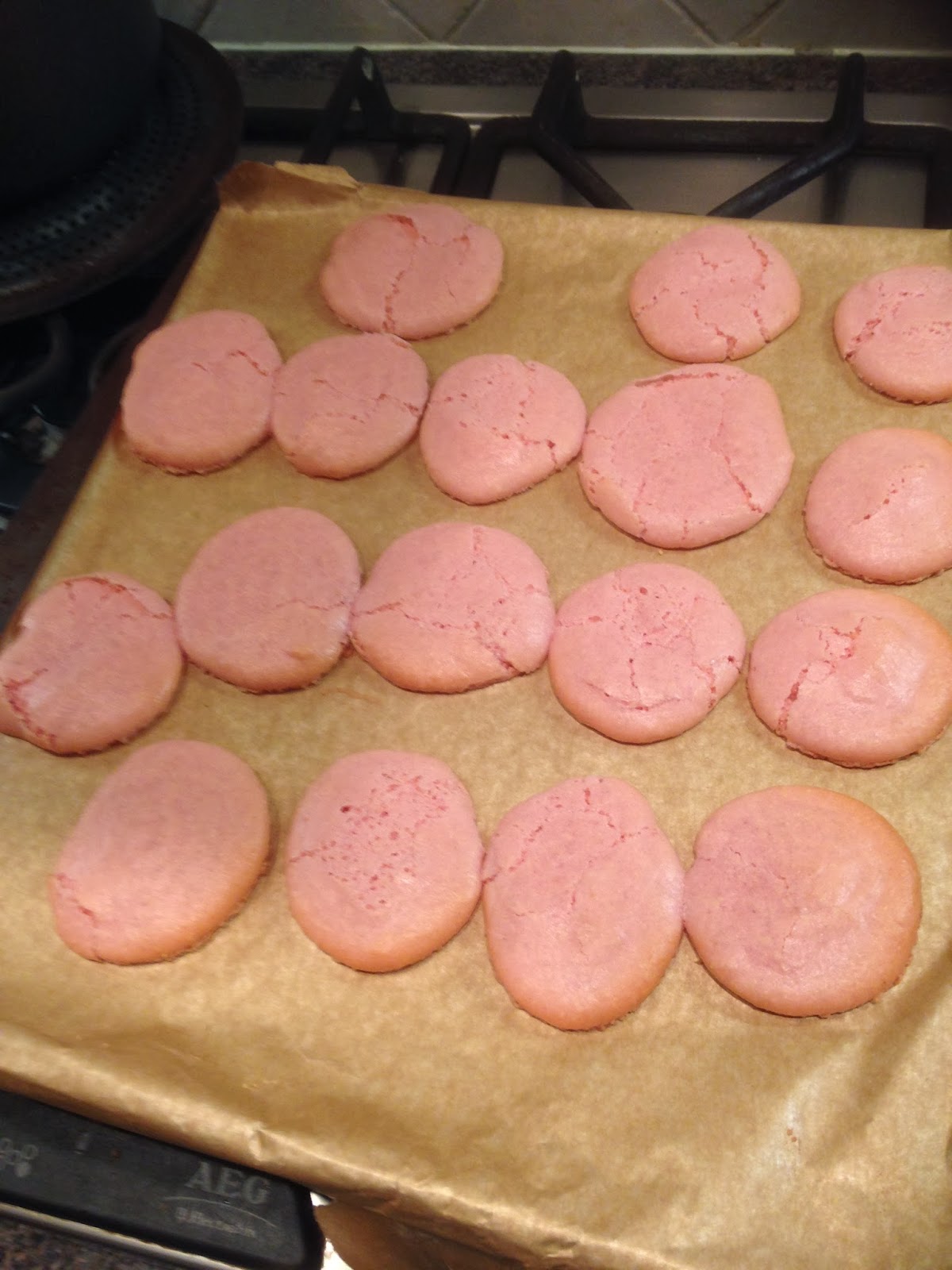
Applying this back to Ibsen’s text the instructions alone shows the attention to detail and skill needed in order to make these successfully. I will put my hands up for possibly being the world’s worst when it comes to using a piping bag, as the misshapen shells in the pictures demonstrate. In saying that, although I followed the recipe word for word I somehow ended up with 14 macaroons! The small amount of food colouring I used made the macaroon a pastel pink, a colour stereotypically associated with femininity. While the shells were light, airy and sweet, the chocolate filling was incredibly rich and slightly bitter due to the dark chocolate. It was this juxtaposition of indulgent flavours that made it impossible to eat more than one per sitting 


Works Cited:
Berry, M. “Macaroons” (2014). BBC Website <http://www.bbc.co.uk/food/recipes/macaroons_16105=>  Date accessed 01/03/14
Ibsen, Henrik. A Doll's House. Trans. Meyer, Michael. London: Metheun Drama, 1991.


Sunday, 2 March 2014

Macaroons and female autonomy (part 1)


It is not often that we think of macaroons as anything more than delicate, small and sweet treats. It is even less likely that the connection between the two shells consisting largely of ground almonds sandwiched between a flavoured filling with feminism. However, for Norwegian playwright Henrik Ibsen’s prose drama A Doll’s House, the representation of the lightly baked confectionary acts as a symbol to challenge the marriage norms in the nineteenth century. First performed in 1879, the naturalistic problem play unearths the deceptions and consequent independence of Nora Helmer from her husband Torvald. Although there are only a few references to macaroons in the play, they become a poignant symbol for Nora’s defiance. Audiences are introduced to this sense of dishonesty at the start of the play, as one of the stage directions defines the conflict between Torvald and Nora, as she “takes from her pocket a bag containing macaroons and eats a couple. Then she tiptoes across and listens at her husband’s door” (23). Although initially this does not seem significant, Nora’s tiptoeing behind her husband’s back suggests to audiences that the Helmer household is not as simplistic as it may initially seem.

Sidney W. Mintz has researched into the morality associated with sugar. He argues that from about the mid-seventeenth century onward, the consumption of sugar, at least in the West, appears to have been colored by moral judgements, both positive and negative” (67). I think by applying Mintz’ ideas of the moral associations of sugar to Ibsen’s play an audience can explore the underlying dialogue of between Nora and Torvald.  It is this duality that ultimately allows an audience to interrogate how femininity should be portrayed in society. From Torvald’s perspective, Nora’s consumption of macaroons suggests a lack of self-restraint. Gail Paster’s theory of the “leaky vessel” (25) could be used to explore Torvald’s logic, as Nora’s gluttonous consumption becomes what Paster describes as “excessive, hence either disturbing or shameful” (25). A masculine moral imperative is constructed, as Ibsen reveals fundamental anxiety surrounding the Victorian housewife, as they could ultimately bring shame to their home and husbands. 

The dialogue between Nora and Torvald in the first act defines gender dynamics in the play, as Torvald lectures Nora, “([wagging] his finger). Has my little sweet-tooth been indulging herself in town today, by any chance?” (27). His question lacks the maturity or respect a conversation expected between two responsible adults. Referring to Nora as “my little sweet-tooth” (27) Torvald refers to his wife using a term of endearment, yet it is incredibly patronising. Once again, the associations with sugar contain a negative connotation, as indulgence becomes synonymous with impulsive and reckless behaviour. Torvald’s stage direction to ‘wag his finger’ at Nora establishes the power dynamics of their relationship reminiscent to a teacher and student or parent and child, as Torvald ‘educates’ his wife how to appropriately behave.


One of the promotional pictures from The Space's production of Ibsen's play depicts the many constraints binding women.


           To contrast, Nora's desire and ultimate consumption of macaroons consolidates her autonomy. Later on in the play she lies to her friend Dr. Rank, revealing why she is prohibited by her husband from eating them while still justifying her reason for eating them:

Nora: Yes, I find it very amusing to think that we – I mean, Torvald – has obtained so much influence over so many people. (Takes the paper bag from her pocket.)
Rank: Macaroons! I say! I thought they were forbidden here.
Nora: Yes, well these are some Christine gave to me.
Mrs. Linde: What? I - ?
Nora: All right, all right, don’t get frightened. You weren’t to know Torvald has forbidden them. He’s afraid they’ll ruin my teeth. But dash it – for one - ! (40)

The hyphens used to split Nora’s first line in this passage acts as a corrective measure, as Nora conforms to abiding and supporting her husband, consequently becoming comic. This effect is heightened by irony, as Nora claims her husband has influence over “so many people” (40), yet she clearly is not including herself in that statement. The effect of these comic techniques distorts the passage that follows, undermining Torvald’s control over her. By once again indulging in the light, sweet confectionary Nora does not appear to be interested in maintaining her looks, an attribute of Nora’s that Torvald apparently polices. Her nonchalance can be read as an act of defiance as she deliberately sabotages her beauty, and thus eradicates what appears to be the main reason Torvald married her. Ibsen’s notes for A Doll’s House in 1878 further explores the pessimistic position of European women of  the late Victorian period, as he explains “[a] woman cannot be herself in contemporary society, it is an exclusively male society with laws drafted by men, and with counsel and judges who judge feminine conduct from the male point of view” (228). It appears that the image or physical staged prop of a macaroon acts as a catalyst for female autonomy against the backdrop of patriarchal control.

It surprised me how throughout the course of Ibsen’s play, a simple action such as sneakily eating a macaroon become a coded measure of domestic defiance.


Works Cited


Finney, Gail. "Ibsen and Feminism." Ed. McFarlane, James. The Cambridge Companion to Ibsen. Cambridge: Cambridge University Press, 2006. 89-106.

Ibsen, Henrik. A Doll's House. Trans. Meyer, Michael. London: Metheun Drama, 1991.

Ibsen, Henrik. "Speeches and New Letters." Kildal, Arne. New York: Print, 1972.

Mintz, Sidney W. Tasting Food, Tasting Freedom: Excusions into Eating, Culture and the Past. Boston: Beacon Press, 1996. Print.

Paster, Gail. The Body Embarrassed. New York: Cornell University Press, 1993. Print. 

Image coursesy of The Indpendent (2014) http://blogs.independent.co.uk/wp-content/uploads/2010/11/DollsHouse_TreatedImage_01-300x212.jpg